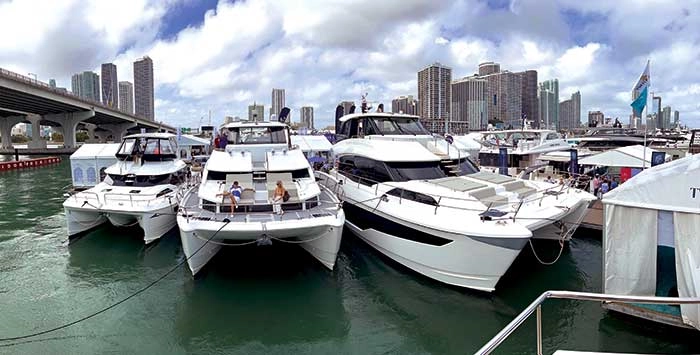
A power catamaran is a motor yacht built on two parallel hulls instead of one central hull. This twin-hull structure gives the yacht a wide beam, generous living space, and a naturally stable feel both underway and at anchor.
Unlike a sailing catamaran, a power catamaran is designed primarily around engine-driven cruising. Without the need for a mast, rigging, or sail-handling systems, the layout can focus more directly on comfort, visibility, deck space, storage, and easy movement between indoor and outdoor areas. For many owners, the appeal is simple: more usable space, less rolling at anchor, and a cruising experience that feels calm, open, and highly livable.

How is a power catamaran different from a monohull?
The most obvious difference is the hull form. A monohull has one main hull, while a catamaran has two. That difference affects nearly every part of the experience on board.
Power catamarans are typically wider than monohulls of a similar length. This creates more interior volume, larger social spaces, and greater separation between cabins. The twin-hull platform also reduces rolling, especially when the yacht is stationary.
A monohull may offer a more traditional yacht feel, with deeper motion through the water and a narrower profile. A catamaran, by contrast, often feels more like a private floating residence: broad, steady, and designed for relaxed time on board.
Key advantages of a power catamaran
A power catamaran can be especially attractive for owners who value comfort, stability, and practical cruising. Common advantages include:
- More living space compared with many monohulls of similar length
- Better stability at anchor and underway
- Wide decks and open entertaining areas
- Strong privacy between guest and owner cabins
- Efficient cruising at moderate speeds
- Shallow draft for access to bays, anchorages, and coastal destinations
- Redundant engine setup, with one engine in each hull
These benefits make power catamarans well suited to families, couples, long-range cruisers, and owners who spend extended time on board.
Space and Comfort on Board
Because the two hulls sit apart from each other, a power catamaran can carry a wide main deck. This often allows for an open saloon, a large galley, panoramic windows, and direct access to outdoor areas.
Main Deck Living
The main deck is usually the heart of the yacht. It connects interior comfort with outdoor cruising, giving owners and guests a shared space for dining, relaxing, and enjoying the view.
What Makes the Layout Practical
When comparing power catamaran layouts, owners often look beyond size alone. The most useful spaces are the ones that support daily routines on board:
- Check how easily guests can move between indoor and outdoor areas
- Look at cabin separation and privacy
- Review storage for longer cruising
- Consider visibility from the saloon and helm
- Think about how the yacht feels both underway and at anchor
A strong layout is not only about square footage. It is about how comfortably people can live, move, rest, and gather throughout the day.
A Power Catamaran Designed for Modern Cruising
The Veya 53 brings the advantages of a power catamaran into a refined cruising platform, combining generous living space, confident handling, and a layout built for extended time on board.
“A well-designed power catamaran should feel spacious without feeling disconnected. The best layouts make movement around the yacht feel natural,” said Nicolas Moreau, Yacht Design Consultant. “Comfort at sea is not only about the size of the yacht. It comes from the way light, movement, privacy, and usable space work together.”
What comes next
The showcase in Cannes strengthened Veya’s position ahead of the official launch of the first Veya 53 in 2026, setting the tone for a new era in power catamarans.


