A power catamaran can be especially attractive for owners who value comfort, stability, and practical cruising. The advantages are not abstract — each one shows up in how a normal day on board actually feels.
More usable living space
For a given length, a catamaran carries far more beam than a monohull, and that width turns directly into living area. The saloon, galley and cockpit sit on one level, connected rather than stacked across decks.
Where the extra volume goes
Most of it goes into the places people actually use: a wider saloon, a full-width aft cockpit, a foredeck lounge, and side decks broad enough to walk without turning sideways.
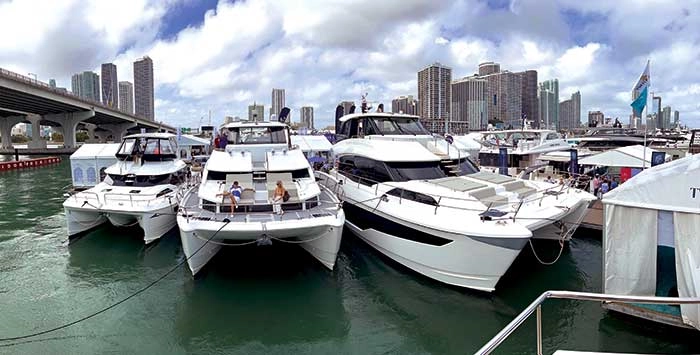
Stability at anchor and underway
The twin-hull platform resists rolling. At anchor the yacht stays level through passing wakes, which is when guests notice the difference most — at dinner, and overnight.
Privacy between cabins
Because cabins sit in separate hulls, guests and owners are not sharing a corridor. The owner suite can occupy one hull entirely, with guest cabins in the other.
Efficiency at moderate speeds
Slender hulls create less resistance than a single wide one, so a power catamaran cruises efficiently at moderate speeds. Range grows accordingly, which changes what a single season can cover.
- Comfortable long-range passages without pushing the engines
- Predictable fuel burn for planning multi-day routes
- Quiet running at cruising rpm
Shallow draft and coastal access
Twin shallow hulls draw less water, opening up bays, sandbanks and coastal anchorages that deeper yachts cannot reach. In practice this means anchoring closer to shore and staying in places others pass by.
Twin engines and redundancy
One engine sits in each hull. Beyond manoeuvring precision, this gives genuine redundancy: a fault in one engine does not end the passage.
“The twin-hull layout is not about numbers on a spec sheet. It is about how many of the yacht’s spaces get used on an ordinary day.”
Who they suit best
These benefits make power catamarans well suited to families, couples, long-range cruisers, and owners who spend extended time on board rather than short trips between marinas.


